
Safety and Health
Fundamental Approach
The Nittobo Group regards the safety and health of its employees as the foundation of its business management.
For this reason, we promote the maintenance of safe working environments and employee education, as well as the sharing of information within the Group. Furthermore, we have established committees at each business site which are engaging in risk management for disasters and accidents.
Action Guidelines
-
1. Establishment of a Safe Workplace Environment
Perform a risk assessment to remove and decrease hazardous and harmful factors and invest in necessary management resources to maintain and improve our safe and healthy working environment.
-
2. Promote Health Maintenance
Proactively assist in the maintenance and promotion of the health of our employees both mentally and physically by establishing a pleasant workplace in which they freely and willingly exchange opinions, and prevent harassment or excessive workload at the workplace.
-
3. Compliance and Management of Labor Policy
Comply with laws, regulations, and other standards regarding safety and health, stipulate independent safety goals and standards, and endeavor to achieve them.
-
4. Implementation of Periodic Inspection
Seek to examine and improve safety and health control systems and to enhance such control standards through the implementation of periodic safety and health inspections.
-
5. Education/Enlightenment
Create safe and healthy working environments across our organization by thoroughly providing all of our employees with safety and health education and to understand safety and health guidelines.
Established on July 1, 2017
Safety and Health Initiatives
To create a safer and more secure workplace, the Nittobo Group is implementing initiatives such as safety and health inspections and fire risk assessments at every business site, as well as making information on safety activities and disaster examples available within the Group.
Major Initiatives for FY2024
| Initiative | Description |
|---|---|
| Workplace Safety and Health Assessments | Business divisions and headquarters departments objectively assess safety and health activities in terms of status, behavior and awareness. Business sites work to improve items highlighted in the assessments, which helps to standardize and enhance safety management across the Group. |
| Safety Improvement Month | We have designated July as Safety Improvement Month, during which we implement various initiatives throughout the Group to reaffirm the importance of occupational safety. These activities include communications regarding safety from senior management, safety awards, and safety activities in which all employees participate. |
| Enhanced Risk Assessments | We are enhancing our hazard prediction training and promoting efforts to raise workers’ awareness of hazards and reflect this in the risk assessments. We are reviewing our work procedure manual and assessing risks at existing facilities and implementing mitigation measures starting with the highest priority facilities. |
| Workplace Fire Risk Assessments | We conducted fire risk assessments to identify issues at each workplace based on a check sheet developed with input from an external expert, and are systematically working to implement improvements to risk management standards at each workplace to prevent fires. |
| Groupwide Information Sharing | We share information including the results of safety and health assessments and fire risk assessments, safety and health best practices, and reports on disaster countermeasures in a standard Groupwide format. Doing so enables us to reflect the experience and knowledge of the Group in the activities of each business site. |
Response to Major Disasters
The Nittobo Group manages risks to mitigate the potential impact of disasters, accidents and other events. To ensure the safety and health of employees is the basis of business management, committees at each business site conduct activities to promote legal compliance and to create safe and pleasant working environments. BCP training attended by Officers and earthquake and fire response drills are also conducted on a regular basis.
- Prioritize the safety and wellbeing of employees and their families.
- Where possible, continue to conduct critical business operations, such as supplying useful products, technologies and services. If business operations are halted, aim to restart as soon as possible.
- Appropriately manage the risk of business disruption and minimize the impact on business management.
- Cooperate with local residents and surrounding local governments as a good corporate citizen.
- Regularly update BCPs and conduct drills to verify effectiveness (annually).
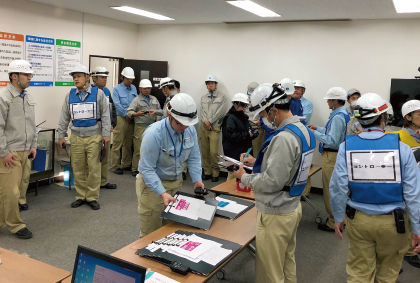
BCP training drill